
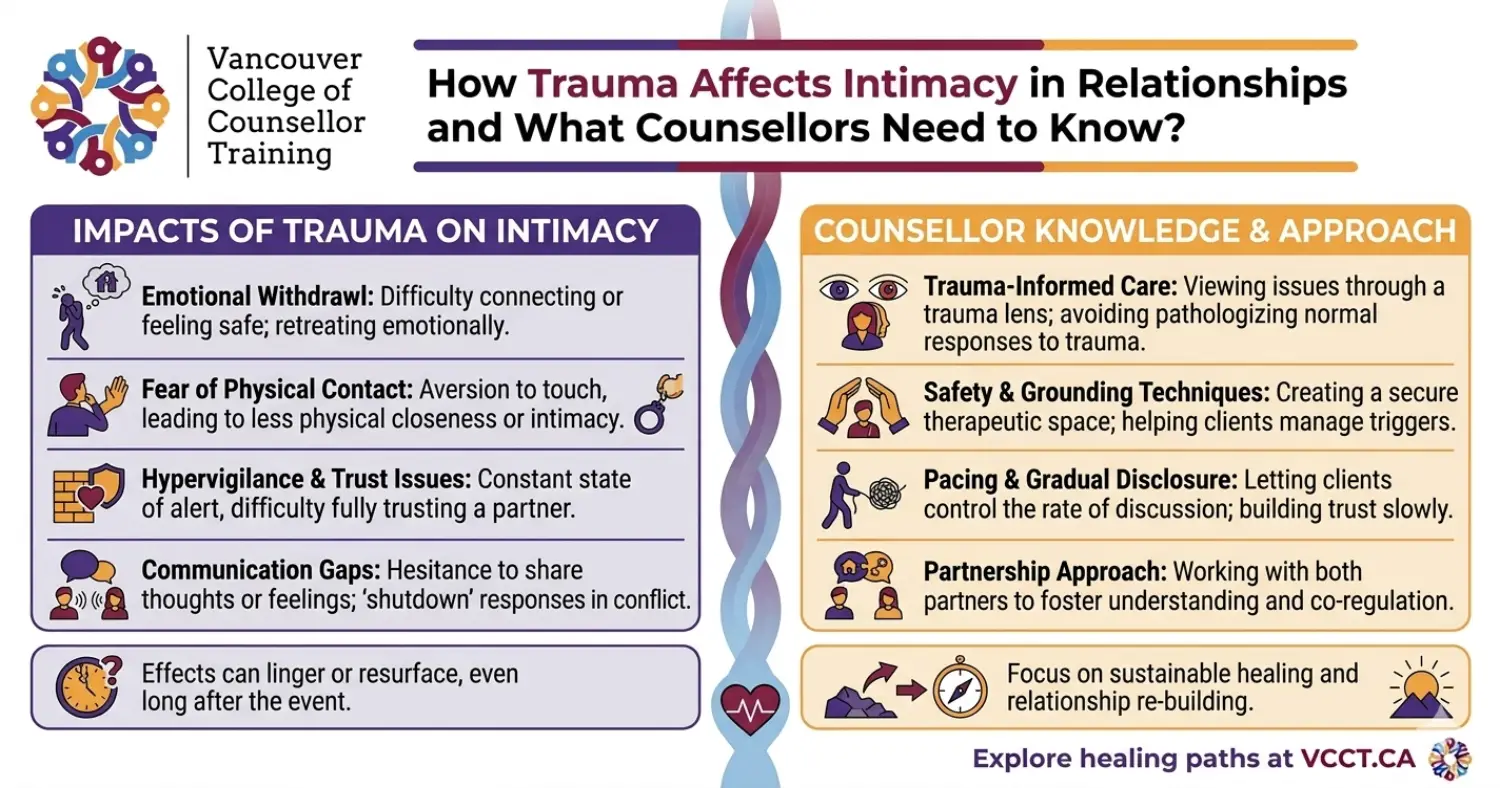
Trauma and intimacy are closely connected. When someone has lived through trauma, closeness in a relationship can start to feel complicated, unpredictable, or unsafe. Emotional vulnerability, physical affection, sexual connection, conflict, trust, and even everyday communication can all be affected. For counsellors, that means intimacy concerns should never be viewed in isolation. They often sit alongside nervous system activation, attachment wounds, shame, fear, avoidance, triggers, or unresolved trauma responses.
In simple terms, trauma can change how a person experiences safety, trust, memory, emotion, and connection. CAMH notes that trauma can affect emotions, memory, thinking, sense of self, and relationships. The U.S. National Center for PTSD also notes that trauma-related symptoms can create problems with trust, closeness, communication, and problem solving in close relationships.
For counsellors, this is why a trauma-informed lens matters. It helps prevent pathologizing normal survival responses and encourages work that centres safety, consent, pacing, collaboration, and choice. SAMHSA defines a trauma-informed approach as one that recognizes trauma’s impact, identifies its signs, responds by integrating trauma knowledge into practice, and actively works to resist retraumatization.
Quick answer
Trauma can affect intimacy by making it harder to trust, relax, communicate, feel emotionally close, tolerate vulnerability, or experience physical connection safely. Counsellors need to understand triggers, nervous system responses, shame, consent, pacing, and scope of practice so they can support clients without retraumatizing them.
What do we mean by intimacy?
In counselling, intimacy is broader than sex. It includes emotional closeness, honesty, trust, mutual regulation, communication, affection, vulnerability, and the ability to feel safe with another person. When people search for information about trauma and intimacy, they are often talking about much more than physical connection. They are asking why closeness suddenly feels difficult, why trust is fragile, or why a loving relationship can still feel unsafe in the body. This broader understanding is especially important in trauma-informed counselling. (PTSD.va)
Not all trauma leads to PTSD, but it can still affect relationships
Not everyone who experiences trauma develops post-traumatic stress disorder. NIMH notes that about 6 out of 100 people will experience PTSD at some point in their lifetime. The National Center for PTSD also notes that in the weeks and months after trauma, many survivors may feel angry, detached, tense, or worried in relationships, while most eventually return to their previous level of closeness. Still, those who develop PTSD may experience more lasting relationship difficulties. (National Institute of Mental Health)
That distinction matters for counsellors. A client may not meet criteria for PTSD and still struggle significantly with trauma and intimacy. They may become withdrawn, hypervigilant, emotionally numb, easily triggered, or highly conflict-avoidant. Counsellors need to respond to what is happening in the room, not only to a diagnostic label.
How trauma affects intimacy in relationships
1. Trust becomes harder to build and maintain
One of the clearest ways trauma affects intimacy is through trust. If a person has learned, through past experience, that closeness can lead to harm, betrayal, neglect, coercion, or humiliation, trusting a partner may feel risky even when the current relationship is safe. This is not stubbornness or lack of effort. It is often a protective adaptation. The National Center for PTSD specifically notes that trauma-related symptoms can affect trust and closeness in relationships.
For counsellors, the practical question is not “Why won’t this client trust?” but “What has made trust feel dangerous?” That shift changes the entire tone of the work. It moves the conversation from blame to understanding, which is essential in trauma-informed counselling.
2. The nervous system can treat intimacy like a threat
A person can consciously want closeness while their body reacts as if danger is present. Trauma can leave people feeling tense, watchful, detached, panicky, or emotionally numb when something in the present reminds them of what happened in the past. CAMH explains that trauma can leave people easily triggered by reminders and can lead to flashbacks, panic, emotional numbing, or a sense of being out of control.
This helps explain why trauma and intimacy often collide in moments that seem ordinary from the outside. A partner’s tone of voice, conflict style, touch, silence, disappointment, or physical proximity may trigger survival responses. A counsellor who understands this will slow down, normalize body-based responses, and avoid interpreting every shutdown or spike in emotion as resistance.
3. Emotional closeness may feel overwhelming
Trauma can make emotional openness feel unsafe. Clients may want connection but fear being seen too deeply, becoming dependent, losing control, or being hurt again. The result may look like distancing, avoiding serious conversations, deflecting affection, changing the subject, or ending relationships when things begin to feel too close. The National Center for PTSD describes this circular pattern well: trauma symptoms can affect how someone behaves with loved ones, and loved ones’ responses can then reinforce the disconnection.
For counsellors, this means emotional distance is often meaningful data. It may signal fear, shame, or dysregulation rather than indifference. Work around trauma and intimacy often begins by making emotional contact feel safer before asking clients to go deeper.
4. Communication and problem solving often suffer
When trauma is active, communication can become reactive, avoidant, defensive, or fragmented. The National Center for PTSD specifically identifies communication and problem solving as areas commonly affected in close relationships. This matters because many couples present with “communication problems” that are actually trauma problems underneath.
A trauma-informed counsellor listens for more than content. They notice pacing, body language, escalation patterns, shutdown, fear of conflict, and whether one or both partners lose access to reflective thinking during difficult moments. Often, what looks like poor communication is really a nervous system protecting itself.
5. Shame can interfere with desire, closeness, and self-worth
Trauma often leaves people carrying a painful story about themselves. They may feel broken, too much, not enough, unsafe to love, or responsible for what happened to them. CAMH notes that trauma can affect a person’s sense of self, which is especially relevant in relationships. Shame can make it hard to receive love, express needs, tolerate care, or feel deserving of healthy intimacy.
This is one reason trauma and intimacy cannot be reduced to technique alone. Counsellors need to hold space for identity, self-worth, meaning-making, and the client’s internal narrative about closeness. Without addressing shame, behavioural advice may stay surface-level.
6. Consent, boundaries, and bodily autonomy may need careful attention
Trauma can complicate boundaries. Some clients become highly guarded. Others freeze, appease, or agree when they do not feel safe enough to say no. This is why counsellors working at the intersection of relationships and trauma need a clear grounding in consent and safety. VCCT’s relationship counselling guidance specifically highlights the importance of knowing when to refer out, how to shift from couples work to individual work, safety planning protocols, and the appropriate use of therapeutic modalities.
That issue becomes even more important if intimate partner violence is present. The National Center for PTSD defines intimate partner violence as violence and aggression between intimate partners and notes that it can include physical, sexual, or psychological abuse, stalking, coercive control, and threats. In those cases, couples work may be inappropriate until safety is addressed.
How trauma and intimacy may show up in counselling
| Trauma-related pattern | What it can look like in a relationship | What counsellors should notice |
| Hypervigilance | Suspicion, scanning for rejection, reacting strongly to minor cues | Safety may feel fragile even when the relationship is caring |
| Avoidance or shutdown | Withdrawing, changing subjects, refusing difficult talks | Distance may be protection, not lack of care |
| Emotional numbing | Feeling disconnected, flat, or “not there” during closeness | The client may need regulation before emotional processing |
| Triggered reactivity | Escalation during conflict, panic, tears, anger, freezing | Seemingly small moments may connect to earlier trauma |
| Shame | Trouble expressing needs, receiving affection, or feeling worthy | Self-concept may be limiting intimacy as much as relationship dynamics |
| Boundary confusion | Difficulty saying no, over-accommodating, or extreme guarding | Consent, autonomy, and pacing need explicit attention |
This table synthesizes trauma and relationship patterns described by CAMH, the National Center for PTSD, SAMHSA, and VCCT. Presentation varies by client, culture, history, and current safety context.
What counsellors need to know
Start with safety, not disclosure
SAMHSA’s trauma-informed approach emphasizes safety, trustworthiness, collaboration, empowerment, and attention to cultural, historical, and gender issues. In practice, that means counsellors should focus first on making the space feel psychologically safe, predictable, and choice-based, rather than pushing for detailed trauma disclosure too early.
Normalize survival responses
Clients often feel ashamed of how trauma affects their relationships. Psychoeducation can be deeply regulating. Explaining that distance, shutdown, hyperarousal, or trigger responses may be protective adaptations can reduce blame and open space for change. SAMHSA’s trauma-informed guidance includes psychoeducation, trigger awareness, and prevention of retraumatization as core treatment objectives.
Work slowly with consent and choice
When trauma and intimacy are linked, pacing matters. Counsellors should check consent often, avoid assumptions, invite rather than push, and help clients notice what feels manageable. This is relevant not only in conversations about physical intimacy, but also in emotional exposure, family-of-origin work, and couples sessions. VCCT’s relationship counselling guidance underscores consent, safety, and ethical clarity as core practice issues.
Screen for coercion and violence
If a client is describing fear, control, threats, stalking, sexual pressure, intimidation, or isolation from support systems, counsellors need to consider intimate partner violence rather than framing the issue only as “poor intimacy.” The National Center for PTSD notes that IPV can include physical, sexual, psychological abuse, stalking, and coercive or controlling behaviours, and that clinicians need knowledge of screening and intervention practices.
Remember that couples work is not always the first step
Some intimacy problems can be addressed in couples counselling. Others require individual stabilization first. VCCT’s consent and ethics guidance explicitly notes the importance of knowing when to refer out and when to transition from couples work to individual work. For counsellors, that means constantly assessing safety, capacity, and fit rather than assuming both partners should always be in the room together.
Stay inside scope of practice
Counsellors need strong boundaries around what they are trained to do. Trauma-related intimacy problems can involve attachment wounds, abuse histories, dissociation, psychopathology, identity concerns, or active violence. A trauma-informed stance includes recognizing limits, consulting, and referring when concerns exceed training or current scope. This is one reason specialized education matters.
Relevant training for this area
For students who want to work more confidently with relationship concerns, VCCT offers a Counselling for Intimacy in Relationships Certificate. The program is 21 weeks, is approved by the Private Training Institutions Regulatory Unit (PTIRU) of the Ministry of Advanced Education and Skills Training, and is designed to help students support clients dealing with intimacy issues in relationships. VCCT says students gain familiarity with contemporary counselling models, communication skills, conflict resolution, healthy relationship patterns, and the impact of psychopathology and sexual identity on intimacy.
VCCT lists courses such as Couples and Marital Counselling, Models of Counselling, Case Study Approaches to Models of Counselling, Sexual Identity & Gender Counselling, Clinical Counselling Skills, Introduction to Psychopathology, and Listening, Asserting & Resolving Conflict. VCCT also notes that the certificate is available on campus or online through distance education.
Final thoughts
At its core, trauma and intimacy is about the meeting point between past danger and present closeness. Trauma can reshape how people interpret affection, conflict, trust, touch, vulnerability, and emotional safety. Counsellors who understand that intersection are better positioned to help clients move from protection to connection at a pace that feels safe and sustainable.
The most important takeaway is this: do not treat intimacy struggles as purely behavioural or relational. Often, the body, the nervous system, and the trauma story are all in the room too. When counsellors lead with safety, consent, curiosity, and clear scope, the work becomes more ethical, more effective, and less likely to retraumatize.
FAQs
-
How does trauma affect intimacy in relationships?
Trauma and intimacy often collide through trust issues, trigger responses, shutdown, conflict sensitivity, shame, or difficulty relaxing into closeness. The person may want connection, but their body or emotions may still react as if danger is near.
-
Does every trauma survivor develop PTSD?
No. NIMH says not everyone who experiences trauma develops PTSD. About 6 in 100 people experience PTSD at some point, but many others still feel trauma’s effects in relationships without meeting full diagnostic criteria.
-
Can trauma affect emotional intimacy and not just physical intimacy?
Yes. Trauma and intimacy include emotional safety, trust, vulnerability, communication, and closeness. Many clients struggle more with being seen, needing others, or staying emotionally present than with physical affection alone.
-
Why do trauma triggers show up in healthy relationships?
Healthy relationships can still activate old trauma patterns because closeness itself may resemble past danger. Tone, touch, conflict, silence, disappointment, or dependence can all trigger survival responses learned earlier in life.
-
What is a trauma-informed approach for counsellors?
A trauma-informed approach recognizes trauma’s impact, notices its signs, integrates that knowledge into practice, and works to avoid retraumatization. SAMHSA highlights safety, trust, collaboration, empowerment, and cultural awareness.
-
Should counsellors always use couples therapy for intimacy problems?
Not always. If coercion, fear, active abuse, or severe dysregulation is present, individual work, referral, or safety planning may come first. Ethical practice includes knowing when couples sessions are not the right starting point.
-
How can counsellors avoid retraumatizing clients?
Counsellors can slow the pace, check consent, offer choices, normalize survival responses, avoid pushing disclosure too early, and help clients track triggers. Trauma-informed work prioritizes safety before deep processing.
-
What are some signs that intimacy issues may be trauma-related?
Common signs include hypervigilance, emotional numbing, sudden shutdown, panic during closeness, strong reactions to conflict, difficulty trusting, shame, and confusion around boundaries or consent in relationships.
-
What should counsellors do if intimate partner violence is suspected?
Counsellors should treat safety as the priority. IPV can include physical, sexual, and psychological abuse, stalking, and coercive control. Screening, documentation, referral, and appropriate safety planning may be more urgent than couples work.
-
Does VCCT offer training related to intimacy in relationships?
Yes. VCCT offers a Counselling for Intimacy in Relationships Certificate. VCCT says the 21-week program covers counselling models, communication, conflict resolution, healthy relationship patterns, and intimacy-related concerns.
-
Is VCCT’s intimacy certificate approved?
Yes. VCCT states that the Counselling for Intimacy in Relationships Certificate has been approved by the Private Training Institutions Regulatory Unit, or PTIRU, of the Ministry of Advanced Education and Skills Training.
-
How can I contact VCCT for more information?
For more information about VCCT, visit 503-333 Terminal Avenue, Vancouver, BC, Canada V6A 4C1, email info@vcct.ca, or call (604) 683-2442 or 1-800-667-3772 for program and admissions details.