
If you have ever wondered whether you need career counselling or life coaching, you are not alone. The two are often mentioned together because both can help people move forward, make decisions, and feel more confident about change. But they are not the same thing.
In simple terms, career counselling focuses on work, education, vocational direction, employability, and career decision-making. It can involve deeper exploration of interests, values, barriers, identity, and complex personal concerns related to career development. Life coaching, by contrast, is generally more future-focused and action-oriented, helping clients clarify goals, reflect on options, and create accountability for change across personal or professional life. CERIC’s glossary distinguishes career counselling from lighter-touch advising, noting that career counselling can involve more psychologically complex career-related concerns, while ICF describes coaching as a partnership that helps clients discover their own solutions through reflection, questioning, and action.
That difference matters for students, clients, and future practitioners. If someone is choosing training, launching a helping career, or deciding what kind of support they personally need, it helps to understand where career counselling ends, where life coaching begins, and where the two may overlap. VCCT itself reflects that distinction in its offerings, with a dedicated Career Exploration & Development Skills Certificate designed around career counselling research, concepts, and employment facilitation skills.
Quick answer
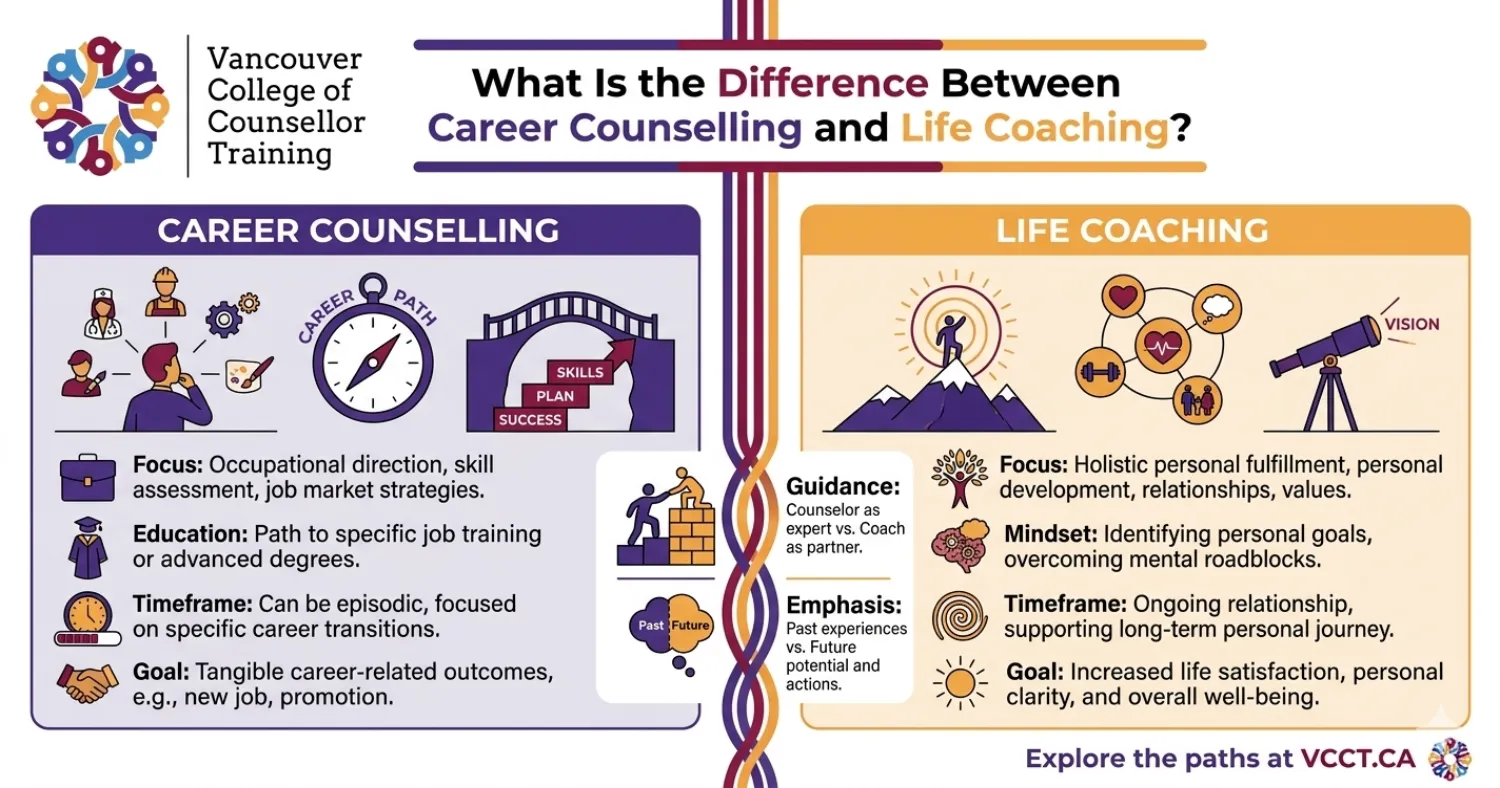
The main difference is this: career counselling is centred on career exploration, work-related decision-making, and employment direction, often using counselling skills, assessments, and labour market information. Life coaching is centred on helping clients set goals, build insight, and take action, usually through reflective questioning, accountability, and future-focused growth.
Why people confuse career counselling and life coaching
It is easy to see why these terms get mixed up. Both may involve one-to-one conversations, personal growth, confidence-building, and support during transitions. A person considering a career change, for example, might speak to either a career counsellor or a life coach depending on what they want help with. Both can ask thoughtful questions, help clarify priorities, and support decision-making.
The difference is usually not in whether growth happens. It is in the focus, depth, methods, and scope of the work. Career counselling is more directly tied to career development theory, labour market knowledge, employability, and vocational decision-making. Coaching is more directly tied to client-driven goals, self-discovery, action planning, and accountability.
Career counselling vs life coaching at a glance
| Area | Career counselling | Life coaching |
| Main focus | Career direction, work, education, employability | Personal or professional goals and forward movement |
| Common topics | Career change, job search, fit, decision-making, barriers | Confidence, habits, priorities, momentum, performance |
| Typical tools | Counselling skills, assessments, labour market information, career development models | Powerful questions, reflection, accountability, action plans |
| Depth of exploration | Can include complex career-related personal concerns | Usually goal-oriented and future-focused |
| Training emphasis | Career development theory, helping skills, assessments, employability | Coaching competencies, active listening, client-led discovery, accountability |
| Best for | People who need clarity around work or education decisions | People who know their direction but want support taking action |
This comparison reflects how NCDA describes career services competencies, how CERIC distinguishes career counselling from lighter advisory approaches, and how ICF describes coaching practice and competencies.
What is career counselling?
Career counselling is a structured helping process that supports people in understanding themselves and the world of work so they can make better career decisions. NCDA’s career assessment guide says the goal of career counselling is to help clients collect, classify, and interpret relevant information about themselves and the world of work, then process that information to make decisions. That makes career counselling especially useful when someone feels uncertain, conflicted, stuck, or overwhelmed by work and education choices.
Career counselling can involve topics such as:
- Choosing a program or training path
- Exploring interests, strengths, and values
- Changing careers
- Returning to work after time away
- Improving job search direction
- Addressing confidence or decision paralysis around work
- Matching personal preferences to realistic employment options
NCDA’s career services competencies also highlight core areas such as helping skills, labour market information, assessment, career development models, employability skills, and work with diverse populations. In other words, career counselling is not only about motivation. It is also about evidence, structure, and informed career decision-making.
CERIC also positions career development as a distinct professional field in Canada, focused on helping people make thoughtful career decisions and improve their economic and social well-being. That Canadian context matters because career counselling is often linked to education choices, community settings, employment services, and broader life design, not just résumé advice.
What is life coaching?
Life coaching is a collaborative process that helps people move toward goals they care about. According to ICF, coaching is a partnership that helps clients discover their own solutions, unlock potential, and create meaningful change through reflection, curiosity, and action. ICF’s competency framework emphasizes trust, active listening, open-ended questions, client reflection, and accountability for growth.
Life coaching often focuses on questions like:
- What do you want next?
- What is holding you back?
- What would progress look like this month?
- What action are you willing to take now?
- How will you stay accountable?
This makes life coaching especially appealing for people who want support with momentum, confidence, habits, life balance, or goal execution. ICF also notes that professional coaching is intended to help clients turn insight into action and move toward sustainable growth.
A responsible coach also needs to understand boundaries. ICF’s guidance says coaching is not therapy, does not diagnose or treat mental health conditions, and should include referral when a client’s needs fall outside coaching competencies. That distinction helps clarify why coaching and counselling should not be treated as interchangeable labels.
7 key differences between career counselling and life coaching
1. Career counselling is work-centred, life coaching is broader
The most obvious difference is the primary topic. Career counselling is specifically built around work, education, vocational identity, and employability. Life coaching can include career goals, but it can also focus on relationships, confidence, productivity, well-being, or personal growth more broadly.
If a client says, “I need help figuring out what career fits me, what training I need, and whether this industry is realistic,” that points more directly to career counselling. If they say, “I know what I want, but I keep procrastinating and need accountability,” coaching may be a better fit.
2. Career counselling often uses assessments and labour market information
A major strength of career counselling is that it can combine personal reflection with structured tools. NCDA includes labour market information, assessment, career development models, and employability skills among key competencies for career services providers. Career counselling can therefore include interest inventories, values exploration, skill mapping, occupational research, and practical discussion about job markets and training pathways.
Life coaching may still include reflection about strengths and possibilities, but it is usually less anchored in formal career assessment and labour market analysis.
3. Career counselling can go deeper into career-related personal concerns
CERIC’s glossary notes that career counselling is different from lighter advising because it can involve more psychologically intense career-related personal concerns. That matters because people’s work decisions are often shaped by fear, family expectations, identity, burnout, confidence, or repeated disappointment. Career counselling can create space to unpack those issues as they relate to career choice.
Life coaching can absolutely involve mindset and self-reflection, but it is usually framed around helping the client generate forward movement rather than exploring complex concerns in the same counselling-based way. ICF’s own materials consistently describe coaching as future-focused, action-oriented, and built around the client’s own solutions.
4. Life coaching is strongly action-driven
One of the clearest strengths of life coaching is momentum. ICF describes coaching as a process that helps clients turn learning into action, design goals, and build accountability. For someone who already has direction but struggles to follow through, that structure can be highly useful.
That means a coach may spend more time on questions like, “What is your next step?” or “What will you commit to this week?” A career counsellor might ask those questions too, but they are more likely to also explore fit, decision quality, career options, and external realities such as training requirements or labour market trends.
5. Training pathways are different
Training is another important difference. NCDA’s Certified Career Counselor credential is intended for practitioners with an advanced counselling degree plus specialized training in career development, theory, and practice. Meanwhile, ICF’s coaching framework is built around coaching-specific competencies such as active listening, trust-building, client reflection, and growth through action.
That does not mean every career professional holds the same credential, or that every coach has the same background. But it does show that career counselling and life coaching are shaped by different professional traditions and competency frameworks.
6. The deliverables can look different
A client leaving career counselling may walk away with clearer occupational options, an assessment-informed picture of their strengths, a program shortlist, job search direction, or a decision about next steps in education or work. A client leaving life coaching may walk away with a mindset shift, a weekly action plan, stronger accountability, or better follow-through toward a self-defined goal.
Both can be valuable. They simply produce different types of clarity.
7. Referral boundaries matter
ICF makes it clear that coaching should stay inside coaching boundaries and that referral is appropriate when a client’s needs are outside the coach’s competencies. That matters because some people seek “coaching” for issues that actually require counselling, therapy, or more specialized support.
In practice, this means career counselling may be the better choice when the client’s difficulty is strongly tied to deeper career-related confusion, barriers, or identity concerns that need more structured exploration. Life coaching may be the better choice when the client is ready to move and mostly needs clarity, challenge, and accountability.
Real-world examples
Example 1: The unsure graduate
A recent graduate says, “I have a degree, but I do not know what kind of work actually fits me. I keep second-guessing every option.”
This person likely needs career counselling. They may benefit from values work, interest assessment, labour market exploration, and a structured look at realistic career paths.
Example 2: The stuck professional
A mid-career professional says, “I know I want to start applying for leadership roles, but I keep avoiding it and talking myself out of it.”
This person may benefit from life coaching, especially if the main issue is follow-through, confidence, and action rather than a lack of career direction.
Example 3: The career changer with mixed concerns
A client says, “I want to leave my current field, but I also feel scared because my identity has been tied to this job for years.”
This could lean toward career counselling, because the issue is both practical and personal. The client may need help understanding options, but also support processing the career-related emotional impact of change.
Can career counselling and life coaching overlap?
Yes, sometimes they do. NCDA’s directory itself notes that career development services may be provided by career counsellors or by other career service providers such as coaches, advisors, and consultants. That tells us there is real overlap in the wider career-help space.
Even so, overlap does not mean sameness. A practitioner may use coaching-style questions inside a career conversation. A coach may help a client think about work goals. But career counselling remains more grounded in career development practice, while life coaching remains more grounded in coaching methodology and client-led action.
Which one should you choose?
Choose career counselling if you need help with:
- Choosing or changing careers
- Understanding your strengths and interests
- Comparing work or education options
- Job search direction
- Career decision-making
- Career-related barriers or confusion
Choose life coaching if you need help with:
- Motivation and momentum
- Confidence and follow-through
- Habit change
- Accountability
- Turning goals into action
- Staying focused on a plan you already believe in
When in doubt, ask what kind of outcome you want. If the answer is “I need to understand my career options and make an informed decision,” start with career counselling. If the answer is “I already know what I want, but I need help doing it,” life coaching may be the better fit.
Training for people who want to work in this field
For students interested in the counselling side of this work, VCCT offers relevant training pathways. Its Career Exploration & Development Skills Certificate is an 18-week program approved by PTIRU and designed to help students explore their own career development while becoming familiar with current career counselling research, concepts, and employment facilitation skills. VCCT says the program is available in both on-campus and distance education formats and includes courses such as Introduction to Career Counselling, Clinical Counselling Skills I, Advanced Counselling Skills, and Case Study Approaches to Career Counselling.
More broadly, VCCT says it has over 35 years of experience, offers practical, career-focused programs, and provides students with access to personalized support during studies, job search assistance, and financial aid options. VCCT is also recognized by PTIRU, which supports its position as a structured training option for students entering the counselling field.
Final thoughts
The difference between career counselling and life coaching comes down to purpose. Career counselling helps people understand themselves and the world of work so they can make informed career decisions. Life coaching helps people clarify goals, build momentum, and take action toward change. Both can be useful. The key is matching the service to the need.
For aspiring practitioners, that distinction matters too. If you are drawn to helping people with career direction, education choices, employability, and vocational decision-making, career counselling may be the better fit. If you are more interested in accountability, performance, and future-focused growth conversations, life coaching may feel more aligned. And for students exploring counselling education, VCCT offers a practical, career-focused environment to begin building those helping skills.
FAQs
-
What is career counselling?
Career counselling helps people understand themselves and the world of work so they can make informed choices about jobs, training, and career direction. It often includes reflection, career tools, and practical planning.
-
What is life coaching?
Life coaching helps people clarify goals, build self-awareness, and take action. It is usually future-focused and centred on progress, accountability, and client-generated solutions rather than career-specific guidance alone.
-
Is career counselling the same as life coaching?
No. Career counselling is work and education focused, while life coaching is broader and more action-oriented. They can overlap, but they come from different practice frameworks and support different needs.
-
When should I choose career counselling?
Choose career counselling when you need help with career direction, training decisions, job search clarity, employability, or understanding what type of work fits your interests, values, and strengths best.
-
When should I choose life coaching?
Choose life coaching when you already know your direction but need help with momentum, confidence, follow-through, habits, or accountability. It is often useful when action is the main challenge.
-
Does career counselling use assessments?
Often, yes. Career counselling may include formal or informal assessments, labour market information, and career development tools to help clients understand fit, options, and realistic next steps.
-
Is life coaching only for career goals?
No. Life coaching can include career goals, but it often also covers personal growth, confidence, focus, balance, habits, leadership, and progress in areas beyond work or education.
-
Can one person offer both career counselling and coaching?
Sometimes, yes, but they should be clear about the role they are using. Good practice means knowing the difference in scope, methods, and boundaries so the client gets the right kind of support.
-
Is career counselling deeper than coaching?
It can be. CERIC notes that career counselling may involve more complex career-related personal concerns, while coaching is generally more future-focused, action-based, and centred on movement toward goals.
-
Does life coaching replace counselling?
No. Coaching is not counselling or therapy. ICF guidance emphasizes that coaches should stay within coaching competencies and refer clients when their needs fall outside the coaching scope.
-
Does VCCT offer training related to career counselling?
Yes. VCCT offers an 18-week Career Exploration & Development Skills Certificate focused on career counselling research, concepts, employment facilitation skills, and practical counselling training.
-
How can I contact VCCT for more information?
For more information about VCCT, visit 503-333 Terminal Avenue Vancouver, BC, Canada V6A 4C1,
Email: info@vcct.ca, or
call (604) 683-2442